
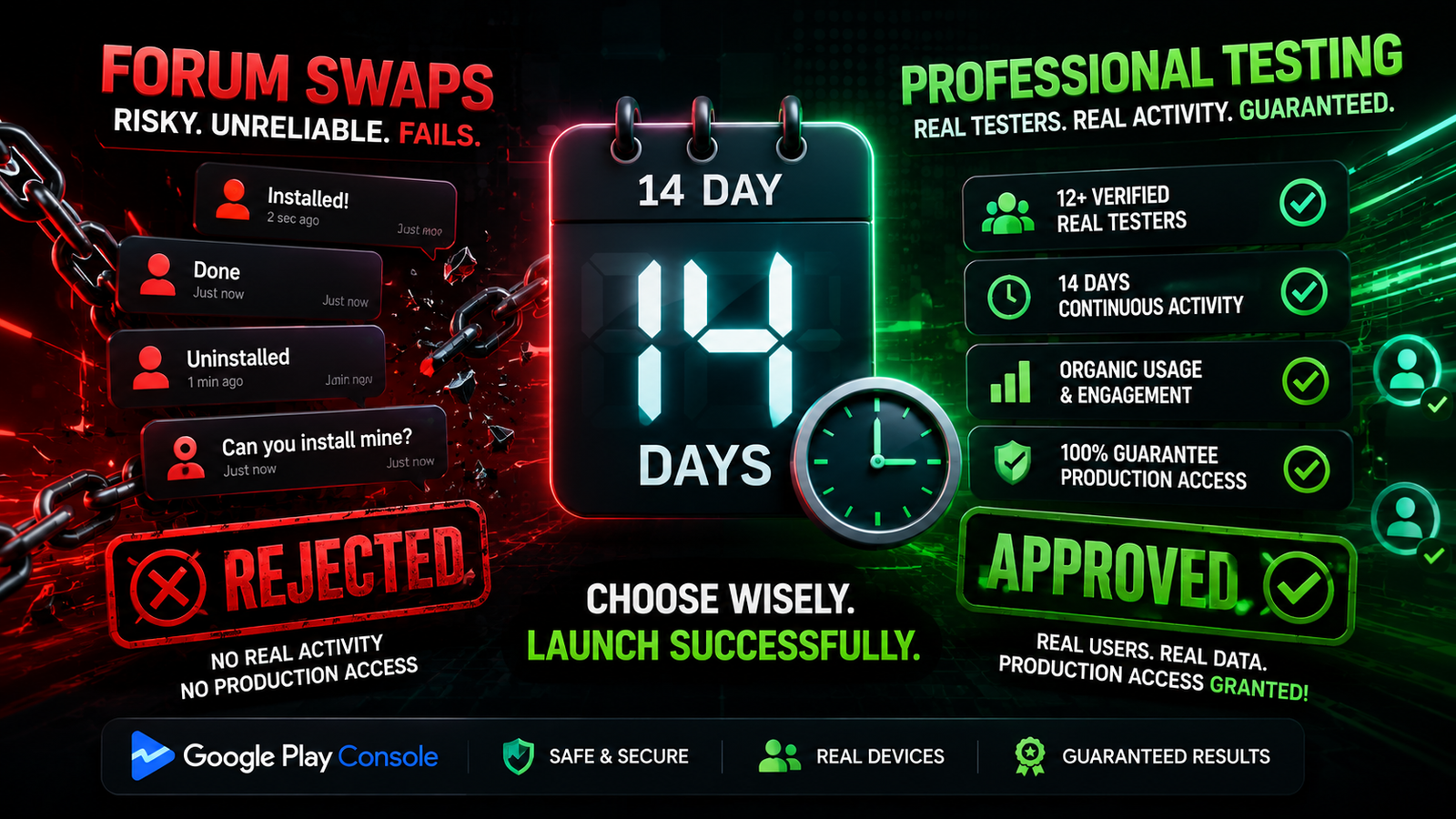
If you are an Android developer looking to launch a new app, you know that the Google Play Store is no longer an open playing field. For personal developer accounts created recently, Google enforces a strict, non-negotiable gateway before you can even touch the "Publish to Production" button: the 14-day closed testing requirement.
You must recruit at least 12 testers who must keep your application installed and actively engage with it for 14 consecutive days.
Faced with this bottleneck, developers usually split into two paths. Some look for free testing alternatives—like trading installation clicks on Reddit forums, Discord servers, or public developer swap-networks. Others invest in Pro Testing platforms to run a managed, automated compliance campaign.
But is free testing actually "free," or does it cost you more in terms of lost market timing, stress, and eventual app rejections?
This comprehensive, data-driven analysis compares Free Testing vs. Pro Testing, exposes the hidden algorithms Google uses to flag fake tracks, and breaks down the most effective way to secure production access on your very first try.
The Reality of Free Testing: The Pitfalls of Community Swaps
The immediate instinct for most independent creators is to look for free app testing services. Many open-source platforms or social media forums operate on an exchange model: "You test my app for 14 days, and I will test yours."
While this sounds like a great deal for a bootstrapped developer, the execution usually fails due to a total lack of accountability.
1. The Inactivity Trap (Shallow Telemetry)
Google’s review systems do not just check if 12 email addresses are whitelisted on your track. They track deep background telemetry via Google Play Services.
Casual community testers practice an "open and close" routine. They click your opt-in link, open the app for three seconds to register an installation hit, and close it immediately. If your entire 14-day history consists of 3-second sessions on the title screen, Google’s automated review flags your track for insufficient tester engagement and denies your production request.
2. The Nightmare of Tester Drop-Off
Internet strangers have zero loyalty to your launch timeline. If a community tester uninstalls your app on day 11 to free up space, your active user count drops to 11. Your 14-day consecutive streak is instantly broken, and the console silently resets your countdown clock to zero—wasting two weeks of work.
3. Emulator Vulnerabilities
Many users in free exchange networks try to manage dozens of apps simultaneously by running virtual desktop emulators or automated scripts. Google easily catches virtual machine signatures. If your data stream originates from emulators rather than real, physical Android smartphones, your entire developer account can face policy warnings.
The Pro Testing Alternative: What Premium Platforms Bring to the Table
Pro Testing platforms transform the 14-day closed testing requirement from a stressful administrative headache into a completely managed QA and compliance campaign.
Instead of chasing down unverified internet users, premium platforms deploy structured networks of real human testers, distinct physical devices, and real-time monitoring ecosystems to guarantee an approval on your first attempt.
To understand why professional tracks pass Google’s subjective manual reviews effortlessly, let's look at the comprehensive engineering, tracking, and compliance architecture built into a premium platform like inTesters:
When it comes to Google Play Closed Testing, the quality of your testers can have a significant impact on the overall testing experience and, ultimately, your chances of a smooth production release.
Many developers initially turn to free testing communities on platforms such as Reddit, Discord, Telegram, and Facebook. While these communities can help developers quickly find testers, they often come with certain challenges. Since participation is usually based on mutual exchanges, testers may install the app simply to receive testing support for their own projects. This often results in limited engagement, inconsistent participation, and a higher likelihood of users abandoning the testing program before the required period is complete.
For example, a developer may successfully recruit 12 testers on Day 1, only to discover a week later that several participants have stopped using the app or have uninstalled it entirely. Managing these situations can become time-consuming and stressful, especially for solo developers or small teams.
Professional testing services take a more structured approach. Instead of relying on volunteer participation, they provide managed testing programs with dedicated testers who remain engaged throughout the testing cycle. This creates a more predictable and reliable testing environment.
Tester Reliability and Retention
One of the biggest challenges with community-based testing is maintaining consistent tester participation. Since there is no formal accountability, testers can leave the program at any time without notice.
Professional testing services are specifically designed to prevent this issue. Testers are managed throughout the testing period, and additional safeguards are typically in place to ensure that participation requirements continue to be met.
Real Device Testing
Another important factor is the testing environment itself.
In community groups, developers often have limited visibility into how and where their apps are being tested. Some participants may use emulators or spend very little time interacting with the application.
Professional testing platforms focus on testing through real Android devices, providing a more accurate representation of how actual users will experience the app across different devices, screen sizes, and Android versions.
Quality of User Engagement
Installing an application is only one part of the testing process. Meaningful engagement is what helps identify bugs, usability issues, performance bottlenecks, and unexpected behavior.
Community testers may only launch an app briefly before moving on to other tasks. In contrast, managed testing programs encourage deeper interaction with the application, including navigating different screens, testing features, and exploring user flows more thoroughly.
Visibility and Progress Tracking
A common concern among developers is not knowing whether testers are actively using the app.
With community-based testing, tracking engagement often relies on manual communication and trust. Professional testing services typically provide monitoring systems, activity tracking, and progress updates that help developers understand how the testing campaign is performing.
Support and Guidance
When using free testing communities, developers are responsible for recruiting testers, managing communication, handling dropouts, and troubleshooting issues on their own.
Professional testing platforms often include dedicated support teams that assist throughout the process. This can be particularly valuable for developers who are unfamiliar with Google Play's testing requirements or who want guidance during the production access application stage.
Which Option Should You Choose?
Free testing communities can be a useful starting point for developers with limited budgets and flexible timelines. However, they often require significant effort to manage and can introduce uncertainty into the testing process.
Professional testing services provide a more organized and dependable approach by offering managed participation, real-device testing, activity verification, and ongoing support. For developers who want a smoother path through Google Play Closed Testing, a structured testing program can help reduce risk and allow them to focus on improving their application rather than managing testers.
Inside the Core Architecture of Pro Testing
A premium android app testing company or professional platform doesn't just provide 12 random installations. They operate an entire compliance ecosystem engineered to satisfy Google’s review board.
A high-tier service includes several key features:
1. Certified, Human Testers
Instead of crowd-sourcing unverified accounts, professional platforms utilize real human testers who are specifically trained through courses like the Google Play Academy. They understand how to interact with your application natively, tap through menus, toggle settings, and stress-test your interface to generate clean user telemetry.
2. Real-Time Tracking & Transparency Dashboards
Pro testing eliminates the stress of guessing whether people are actually launching your app. Developers get access to a centralized Testing Dashboard that provides live tracking:
Real-time active tester counts and campaign status updates.
Granular tester activity logs.
Verifiable device and OS coverage statistics showing your app works smoothly across different Android API levels and hardware brands (Samsung, Pixel, OnePlus, etc.).
3. Fraud Prevention & AI Screenshot Verification
To ensure testers are performing their duties diligently, advanced networks implement strict compliance protocols. Testers are required to submit daily visual proof of their sessions. The platform uses AI Verification Systems to analyze these screenshots, instantly validating that the app was launched on an active physical device and confirming genuine engagement.
[Tester Opens App] ➔ [Captures Active Session Screenshot] ➔ [AI Scans and Validates Proof] ➔ [Data Logged to Developer Dashboard]
4. End-to-End Compliance & Questionnaire Support
The testing track is only phase one. Once the 14 days are complete, you must fill out Google's strict 10-question Production Access Questionnaire. This form asks for deep, technical details regarding your testing methodology and what bugs were discovered.
Pro Testing services provide you with pre-mapped technical logs, device coverage charts, and expert recommendations, helping you complete the application form flawlessly.
Hybrid Platforms: The Best of Both Worlds
If you are a bootstrapped developer who still wants professional oversight without an upfront cost, some platforms offer a unique hybrid model.
For instance, the inTesters platform combines an organized free community exchange with their premium tier. In their free ecosystem, you can earn points by testing other developers' apps and then spend those points to get your own app tested for free.
The major benefit? Even on the free tier, your project runs through their centralized dashboard, offering far better structure, tracking tools, and screenshot verification than random, unmonitored Reddit or Discord threads.
Summary: Which Should You Choose?
If you are building a simple hobby app with no strict launch deadline, a free community testing network or a structured points exchange can get you started. However, you must actively manage your users to prevent sudden uninstalls and shallow engagement loops.
If you are launching a commercial application, a startup MVP, or a mobile game where time-to-market is critical, Pro Testing is the superior choice. Investing in a professionally managed track completely eliminates the risk of a 14-day reset loop. It replaces unreliable forum swaps with guaranteed delivery, real physical hardware, AI-verified proof logs, and dedicated human support. Treat your publishing phase with professional gravity, protect your launch timeline, and secure your path straight to the public Play Store on your very first try.
About the Author

Pratyush Kumar Thakur
Expert software tester and contributor to the community. Passionate about AI, automation, and user experience.