
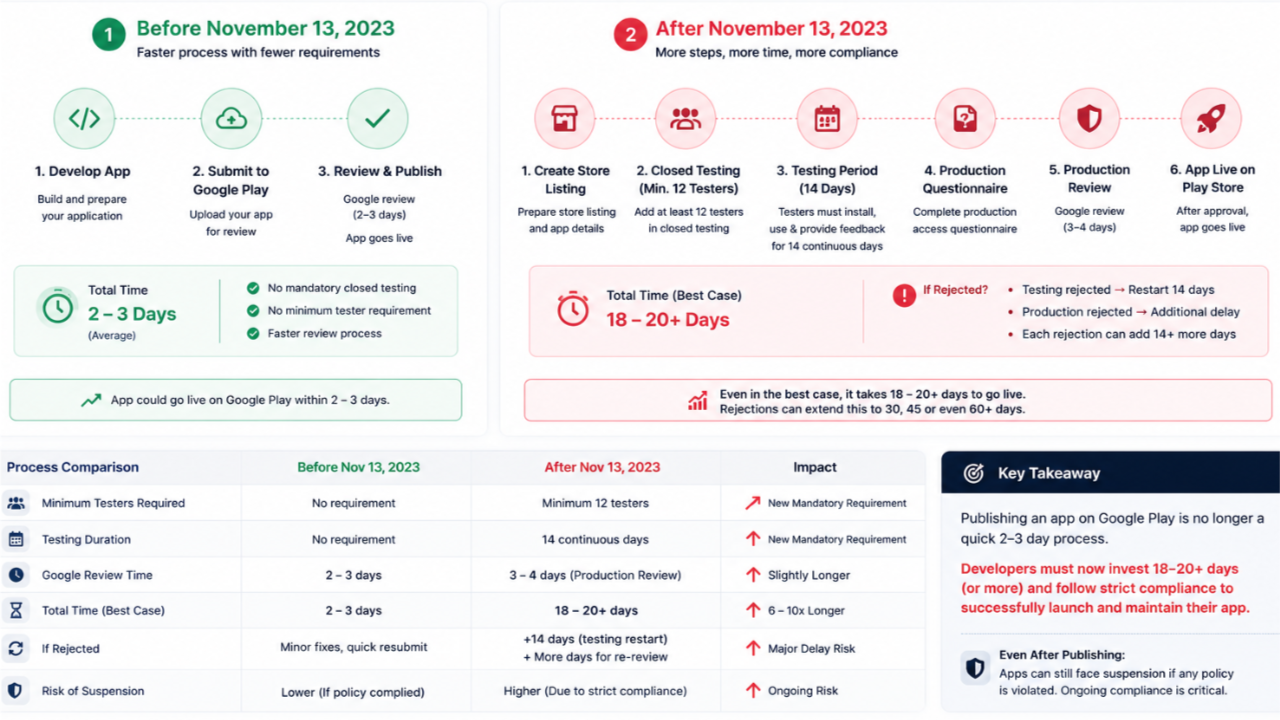
For most developers, the entire publishing journey could be completed within a week. Today, that's no longer the reality.
A few years ago, launching an Android app was relatively straightforward. The entire publishing journey felt smooth, predictable, and could easily be wrapped up within a single week. The workflow was basic:
Develop the app and squash the major bugs.
Open Google Play Console, set up a basic store listing, and upload your Android App Bundle (
.aab).Wait 2 to 3 days for a standard security review.
Watch your app go live globally.
Today, that frictionless launch cycle is completely dead.
Following a series of aggressive policy changes by Google targeting low-quality software and spam, publishing a new app has evolved into a high-stakes, multi-stage compliance race. For modern indie developers and startups operating new personal developer accounts, the administrative overhead can easily take longer than writing the actual code.
The New Publishing Blueprint: Mapping the 18-Day Timeline
You can no longer build an app over the weekend and expect it to be on the store by Wednesday. Google has introduced a series of mandatory operational gates that every personal developer must clear.
Before your app can become publicly available for search or download on Google Play, you are forced to navigate a strict sequence:
[Store Listing Setup: 1-2 Days] ➔ [Closed Testing Track: 14 Days] ➔ [Production Review: 3-4 Days] = 18-20+ Total Days
Store Listing & Content Declarations (1–2 Days): Filling out complex data safety questionnaires, defining target audiences, uploading privacy policies, and designing compliant store graphics.
The Closed Testing Phase (14 Days): Configuring a private track, whitelisting users, and maintaining a live pool of at least 12 active testers for 14 continuous, uninterrupted days.
The Production Access Questionnaire (Internal Admin): Completing a rigorous, 10-question technical application detailing your testing methodology, discovered bugs, and engineering iterations.
The Final Production Review (3–4 Days): A manual and automated deep-dive by Google's review board to approve or deny your entry into the public market.
If you execute every single step flawlessly on your very first try, your minimum time-to-market is 18 to 20+ days.
The Cost of a Single Rejection: The 14-Day Reset Loop
The real danger of the modern Play Console setup isn't the initial 18-day timeline; it’s the penalty for failing Google's subjective manual review.
If Google’s automated review systems or manual testers conclude that your closed testing track lacked "sufficient engagement," your application for production access will be flatly rejected.
A rejection doesn't mean a quick patch and a few hours of delay. It resets the entire 14-day testing clock.
[Rejection Received] ➔ [Recruit New/Active Testers] ➔ [Run Another 14-Day Cycle] ➔ [Resubmit Questionnaire] ➔ [Wait for 3-4 Day Review]
One single rejection pushes your launch window past the one-month mark. Two rejections can trap an independent project in a demoralizing administrative loop that drags on for months, draining momentum and killing market timing.
Why the "Friends & Family" Strategy is Triggering Rejections
When faced with recruiting 12 testers, the immediate instinct for most developers is to text a group of friends or trade installation clicks on free developer swap-forums on Reddit, Facebook, or Discord.
This casual approach is the exact reason why thousands of production applications are currently being denied. Google’s console doesn’t just check if 12 email addresses downloaded the app; their telemetry actively tracks user behavior metrics:
The Inactivity Trap: If your friends open the app for five seconds on day one and never touch it again, Google flags the session data as superficial and manufactured.
The Retention Drop: If a single forum user uninstalls your app on day 11 to free up storage space, your active tester count drops to 11. Your 14-day consecutive streak breaks instantly, and the console silently invalidates your progress.
Hardware Footprints: Group-swap users often utilize emulators or virtual machines to manage multiple installations. Google flags identical hardware configurations, which can lead to strict policy violations or account reviews.
Secure Your Launch Pipeline with Professional Testing
This shift in Google's ecosystem means you are no longer just an application developer—you are a compliance manager, a QA coordinator, and an administrative strategist.
If you cannot afford to risk a 14-day reset loop, or if you simply want to focus on building features rather than chasing down unreliable internet strangers for their Gmail addresses, the most strategic choice is to secure a managed professional testing service before launching your track.
By deploying an established network of verified, real-world testers using distinct, physical Android devices, a professional service generates the pristine, deep-engagement telemetry that Google’s review board demands.
A Premium Managed Service Eliminates the Risk By Providing:
Guaranteed 14-Day Cycle Continuity: Continuous monitoring to ensure your track parameters remain perfectly stable without a single day of data drop-off.
20+ Vetted, Real-Device Testers: A deep safety buffer of real users on physical smartphones, completely eliminating emulator flags.
Deep Session Engagement: Trained testers who actively interact with your user interface for a minimum of 2–3 minutes daily, thoroughly exploring pages to build organic retention profiles.
Comprehensive Diagnostic Data: Structured feedback logs detailing performance across diverse Android OS versions and hardware configurations (Samsung, Pixel, OnePlus, etc.).
Form Approval Guidance: Direct engineering support mapping out your technical test data to help you confidently ace Google's strict 10-question production access application.
Final Thoughts
The Google Play Store is no longer an open wild-west for rapid deployment. It is a highly regulated, tightly policed enterprise marketplace. Navigating the closed testing gauntlet requires professional discipline, deep user engagement tracking, and absolute technical accuracy. Treat your testing phase with the same engineering gravity as your codebase, protect your launch timeline from costly reset loops, and build your path straight to production access on your very first try.
About the Author

Pratyush Kumar Thakur
Expert software tester and contributor to the community. Passionate about AI, automation, and user experience.